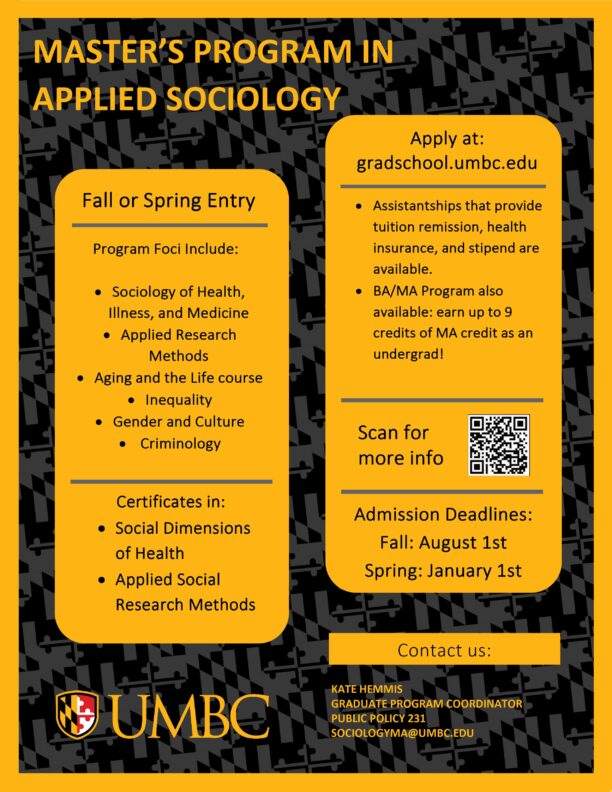
The Department of Sociology and Anthropology at UMBC offers a graduate program leading to a Master of Arts degree in Applied Sociology. The degree program in Applied Sociology emphasizes the “practical side” of sociology and the acquisition of analytic skills to prepare students for employment in many professional settings, including public and private organizations involved in social research, social policy, and program development. Program foci include sociology of health; sociology of aging; selected areas of diversity, gender, and culture; and applied research methods. Graduates of the program work at the Center for Medicare and Medicaid Services (CMS), the Social Security Administration, the National Institutes of Health, the National Institute of Aging, the Bureau of the Census, the Maryland Department of Health and Mental Hygiene (DHMH), medical school and university research centers, non-profit organizations, and private research organizations.
The UMBC MA program in Applied Sociology awards as many as 20 MA degrees annually, making it one of the largest MA-only sociology graduate programs in the United States. Our program has a community of about 60 MA students taking courses at any time. Many courses are offered exclusively to MA students while others are open to both graduate and advanced undergraduate students. The program is designed to be completed on a full-time or part-time basis. Courses are offered at 4:30-7:00 pm or 7:10-9:40 pm one day per week Monday through Thursday to accommodate students with full-time employment or other obligations. Students can enter the program either in the fall or spring semesters, with December 15 as the deadline for spring admission and July 1 for fall admission.
A Graduate Certificate in the Nonprofit Sector is offered either separately or as part of the MA program. It consists of 4 courses, including 2 courses that analyze nonprofit organizations, 1 course in methods or statistics, and 1 course in a substantive area relevant to nonprofit organizations. These courses also count toward the MA degree, which permits MA students to complete the certificate without taking additional courses.
A number of assistantships are available in the Department of Sociology and Anthropology and elsewhere on and off campus. Assistantships require 10 to 20 hours of work per week and provide tuition remission, health insurance, and a stipend. Assistantships are assigned on a competitive basis. Teaching assistantships in the department are usually awarded to students in their second semester in the program.
Requirements for admission include a bachelor's degree from an accredited institution with a GPA of 3.0 (on a 4.0 scale) or higher. Those admitted to the program must have completed an undergraduate course in statistics in any department in any college with a grade of C or better within the past five years. Students who have not completed this requirement must complete an undergraduate statistics course in any college or community college prior to admission. The GRE is not required. Students with GPAs slightly below 3.0 may be admitted provisionally as Special Advanced Students. If they receive grades of B or better in 2 graduate courses, they are eligible for admission as regular MA students. If admitted, they will receive graduate credit for those courses. See UMBC's Graduate School Admissions Policies for more information.
Students interested in applying to the MA program should email Professor William Rothstein, Graduate Program Director, at rothstei@umbc.edu or Elise Bruner, Program Management Specialist, at elise3@umbc.edu.
The MA in Applied Sociology program consists of 10 courses totaling 30 credits. Required courses include one methods course (SOCY 600), one statistics course (SOCY 604), and another approved methods or statistics course (for example SOCY 618 - SAS, SOCY 619 - Qualitative Methods, or an advanced statistics course such as ECON 611 or PSYC 711). The remaining courses are a combination of elective courses and Thesis or Analytical Paper courses. A total of two courses may be taken outside the department, but they must be approved by the Graduate Program Director prior to enrollment. Students may also enroll in one graduate-level three credit Independent Study course as part of their elective course requirements.
A normal full-time load is 9 credits (3 courses) per semester. Most full-time students can complete the program in 3 semesters plus a summer or winter session course. Full-time students who begin the program in the Fall semester will take SOCY 600 and proceed to SOCY 604 in the Spring. Students who begin in the Spring semester will take elective courses their first semester, SOCY 600 in the Fall semester, and SOCY 604 in the next Spring semester. Part-time students usually complete the program in 2 to 2.5 years. Part-time students who are employed full-time are strongly urged to take only one course their first semester at UMBC. If they find that they are capable of taking an additional course, they can take two courses in subsequent semesters. All students must have a cumulative GPA of 3.0 or better order to graduate.
Degree-seeking students in the Applied Sociology program may choose either the Thesis option (15 course credits and 6 Thesis credits) or the Analytical Paper option (18 course credits and 3 Analytical Paper credits). Both courses of study require 30 hours of course work. The Thesis option is designed for students who plan to enter doctoral programs and is recommended for students interested in community college teaching. The Thesis option requires a committee chair and two faculty members. The Analytical Paper option is more appropriate for students entering or continuing professional careers following the MA degree. The Analytical Paper option requires two faculty readers.
Early in their academic careers, students must decide whether to pursue the Thesis or Non-Thesis option and select a thesis chair or first reader of their analytical paper who will also serve as their faculty advisor. Students should maintain close contact with their faculty adviser in order to develop a viable program of study and avoid graduation delays. When a research topic has been agreed upon, students, with assistance of their faculty adviser, will develop either an Analytical Paper outline or a Thesis proposal, and the student will register either for 3 credits of Analytical Paper Research (SOCY 711) in one semester or 3 credits of Thesis Research (SOCY 799) in each of two semesters. Students cannot enroll in these courses without the permission of their formal adviser. Students should become familiar with the university's requirements and deadlines for organizing and submitting the analytical paper or thesis. All students must select a thesis chair or first reader after they have completed 18 credits in the program.
The Thesis is approved by a committee consisting of a committee chair and two committee members. The chair assists the student in selecting the two other members of the Thesis committee. The student works with the chair to prepare a Thesis proposal, which is approved by the committee after an oral thesis proposal defense. Upon completion, the Thesis is presented in an oral thesis defense to the committee for approval. This process takes two semesters. An Analytical Paper is an extensive research paper and can consist of a literature review of a research question or involve original research. The faculty adviser assists the student in selecting the second reader of the paper. The student works closely with both readers to complete the paper, which always takes longer than one semester. The student should therefore begin work on the analytical paper before the last semester at UMBC.
See Graduate Catalog for a complete listing of all courses and degree requirements, as well as course description.
1. Required Courses (9 Credits)
2a. Thesis Option (21 credits)
A committee consisting of a chair and two other faculty members will approve the thesis proposal and the thesis.
2b. Analytical Paper Option (21 credits)
A first and second reader will approve the Analytical Paper.
Regularly offered elective courses are listed below. Most of these courses are offered annually while others are offered periodically.
Please refer to the graduate catalog for a full listing of courses offered. Refer to schedule of classes for current semester offerings. For more information, call 410-455-3365.